
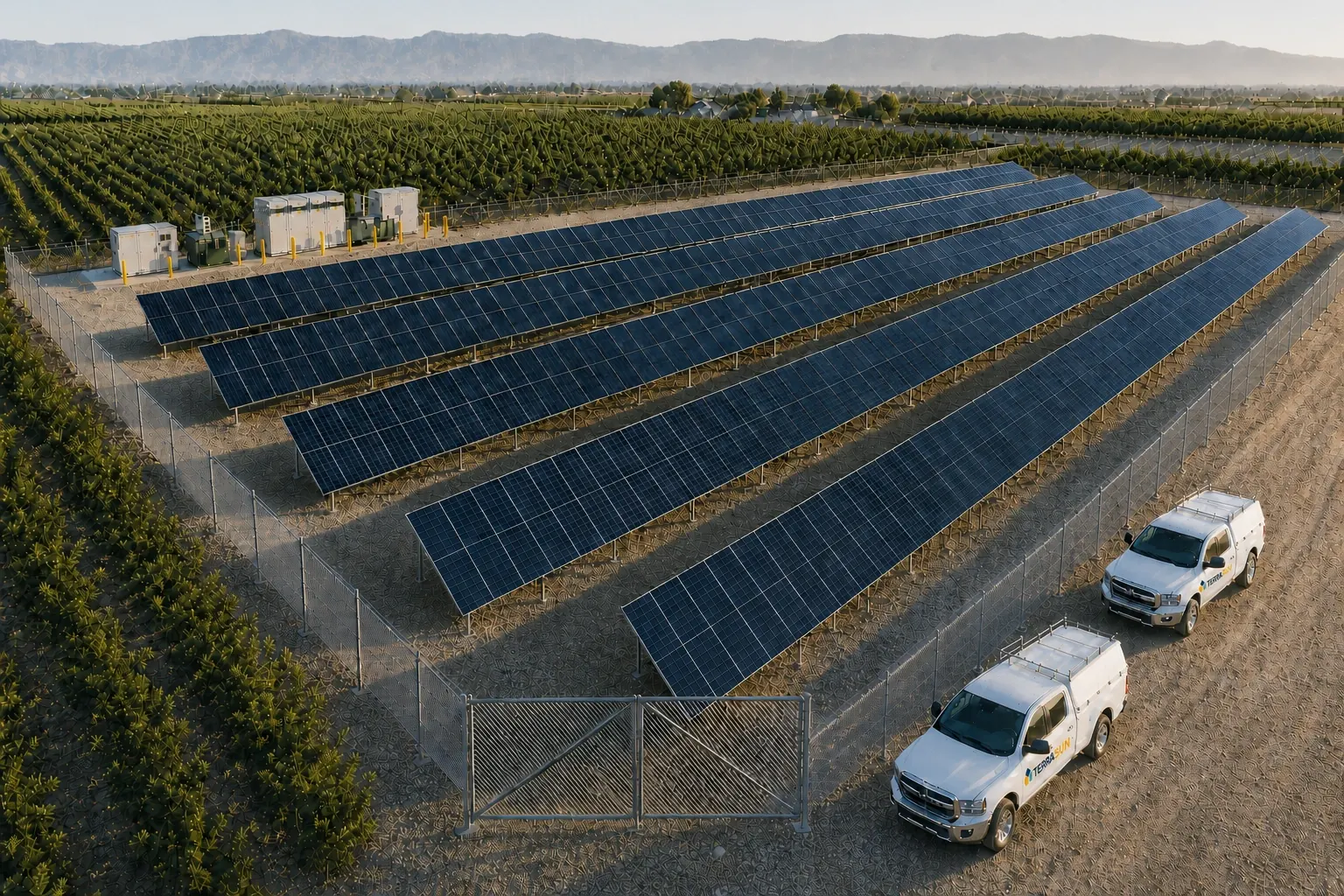
Yes—agricultural solar monitoring without cell service works when the site has another internet connection, such as wired broadband, a wireless bridge to connected farm buildings, or satellite internet. Without any working connection off-site, compatible equipment can record data locally, but remote operators cannot receive live readings or new fault alerts until communication returns. At TerraSun Energy Services we assess the existing monitoring setup and help define connectivity responsibilities within the agreed O&M scope for commercial and agricultural owners across California's Central Valley and Central Coast.
- Agricultural solar monitoring without cell service requires another communication path for remote visibility.
- Wired broadband, wireless bridges, and satellite internet serve different farm layouts; verify compatibility before choosing.
- Local logging preserves supported records but does not deliver live remote alerts during an outage.
- We provide 24/7 solar O&M monitoring and in-house field repairs for Central Valley and Central Coast owners.
Can agricultural solar sites be monitored without cell service?
Yes. Cellular service is one way to transport monitoring data, not a requirement for measuring solar production. The important distinction is between collecting measurements at the array and delivering those measurements to someone off-site.
For your 2026 O&M scope, separate the equipment connection, the internet connection, and the response process. A functioning internet router does not prove that inverter data reaches the monitoring platform—or that anyone acts on an alarm. Define those responsibilities in your solar operations and maintenance scope.
| Connection approach | Best for | Advantage | Limitation to resolve |
|---|---|---|---|
| Wired broadband or farm network | Arrays near an existing connected building | Uses an established internet connection | Route, distance, electrical protection, and network permissions need assessment |
| Point-to-point wireless bridge | Arrays separated from connected farm buildings | Carries network traffic without a continuous cable route | Requires a suitable radio path, mounting, power, and an upstream internet connection |
| Satellite internet | Sites without a suitable terrestrial connection | Provides an alternative connection off-site | Requires suitable sky visibility, compatible networking, power, and service management |
| Local logging with later retrieval | Sites accepting delayed access to operating records | Can retain supported data during communication gaps | Does not provide live remote monitoring while disconnected |
These are communication approaches, not interchangeable monitoring systems. Confirm that your inverter, meter, gateway, and monitoring platform support the proposed arrangement before approving installation.
Why this matters
A solar array can keep generating while its monitoring connection fails. An inverter can also stop generating while the monitoring connection remains healthy. Treating both conditions as the same alarm creates unnecessary site visits and leaves genuine equipment faults unresolved.
Your 2026 maintenance agreement should distinguish communications unavailable, equipment unavailable, and production outside expectations. Each condition needs an assessment path and a named person responsible for follow-through. A dashboard alone does not establish which condition exists.
Wired broadband: best for nearby connected buildings
A wired network connection is a practical starting point when a farm office, packing facility, or equipment building already has dependable internet access. The monitoring gateway connects through the farm network rather than through a cellular modem.
The benefit is straightforward: you use an existing route off-site. The limitation is that the solar monitoring system now depends on farm networking equipment, its power supply, and whoever controls access to it.
Ask the provider to document:
- The connection between the inverter or meter and the gateway.
- The physical network route between the array and connected building.
- Responsibility for routers, switches, protective equipment, and damaged cabling.
- Required network permissions and any remote-access arrangements.
- What happens when farm staff replace a router or change network settings.
Choose wired connectivity only after the route and equipment requirements are checked. Do not assume that an available network socket provides a suitable outdoor connection or that an existing cable can serve the proposed distance.
Wireless bridges: best for separated farm buildings
A point-to-point wireless bridge carries network traffic between fixed locations. For example, it can connect an array-side gateway to a farm building that already has internet access.
The bridge does not create internet service by itself. If the building loses its upstream connection, the array loses that route to remote monitoring too.
A suitable radio path matters. Terrain, buildings, trees, mounting positions, and agricultural activity can affect the design; a clear-looking view alone is not a completed radio assessment.
The advantage is avoiding a continuous network cable route across the property. The trade-off is additional outdoor equipment that needs mounting, power, protection, and maintenance.
Choose a wireless bridge when a site assessment confirms the path and ownership of the supporting equipment. Include troubleshooting responsibility in the O&M scope rather than leaving the bridge between the solar contractor and farm IT provider.
Satellite internet: best for sites without a suitable land connection
Satellite internet provides a non-cellular route off-site when wired service or a bridge to an existing connection is unsuitable. The solar gateway still needs to communicate through the local network and remain compatible with its monitoring platform.
The advantage is independence from local cellular coverage. The limitation is that satellite service introduces its own equipment, siting, power, and account-management requirements.
For a 2026 procurement decision, ask the proposed provider to verify the current service requirements at the actual installation location. Do not select an arrangement solely because a connection works temporarily beside the farm office.
Confirm these points before approval:
- The terminal location has the visibility its service requires.
- The mounting location suits farm operations and maintenance access.
- The gateway can send data through the proposed network configuration.
- Someone owns the service account and tracks connection faults.
- Loss of terminal power is distinguishable from a solar equipment fault.
Choose satellite after checking the full monitoring path, not just internet access on a phone or laptop.
Local logging: best for delayed records, not live alerts
Local logging stores measurements at the site for later retrieval or transmission. Whether that works depends on the specific inverter, meter, or gateway; storage and backfill capabilities are not universal.
Its advantage is continuity of supported records during communication gaps. Its limitation is operational: a remote maintenance provider cannot act on a new fault it has not received.
Ask what the equipment records, how timestamps are maintained, what happens when storage fills, and whether records upload automatically after reconnection. Confirm whether historical alerts are delivered, not just historical production readings.
Do not describe local logging alone as continuous remote monitoring. It is a data-retention measure, and your maintenance plan must address the period without remote visibility.
How do you set up agricultural monitoring without cellular coverage?
Build the connection around the operating equipment and maintenance workflow. For an existing array, preserve useful monitoring hardware where compatible rather than assuming that a new internet connection requires replacing the entire monitoring system.
- Map equipment. Identify inverters, production meters, gateways, communication interfaces, and platform access. Record which devices currently provide data and which remain unobserved.
- Assess connectivity. Check existing broadband, possible bridge locations, and satellite siting. Verify the actual gateway location, not merely the nearest occupied building.
- Confirm compatibility. Establish how measurements reach the gateway and how the gateway reaches the platform. Check account permissions, network requirements, and supported outage behavior.
- Test alarms. Verify that an authorized recipient receives a communication-loss event and can distinguish it from an equipment fault. Conduct tests under an agreed procedure without unnecessary electrical intervention.
- Assign follow-through. Define who assesses alerts, authorizes field work, completes repairs, and documents the outcome. Keep unresolved faults visible until their status is explained.
Acceptance should demonstrate the complete path from equipment data to the person responsible for action. A successful internet connection test alone does not establish that the monitoring service is working.
Why the right connection varies by agricultural site
Use these factors to compare proposals rather than asking only whether an alternative to cellular exists:
- Existing infrastructure: A connected farm building changes the options available to a remote array.
- Distance and terrain: Cable routes and radio paths need different assessments; neither follows directly from map distance.
- Equipment compatibility: A gateway's interfaces, software, and platform requirements determine which connection designs are usable.
- Power dependencies: Routers, bridges, gateways, and terminals need power; communication equipment can fail independently of production equipment.
- Operating conditions: Heat, moisture, corrosion exposure, and equipment placement affect outdoor communication hardware.
- Maintenance ownership: A connection that nobody is responsible for troubleshooting leaves a gap between monitoring and repair.
For a Central Valley site, assess equipment heat exposure, dust, irrigation-related moisture, and access around agricultural work. Position communication equipment so that routine farm activity does not undermine access or protection.
For a Central Coast site, assess moisture, salt exposure where applicable, corrosion, drainage, and local terrain. Give enclosures, connectors, and mounting locations the same attention as the internet service itself.
Neither region has a single correct connection type. Select the connection from the site's conditions and the monitoring equipment's requirements.
What should your maintenance contract include?
A 2026 agricultural solar O&M contract should connect detection to assessment, corrective work, and documented follow-through. Separate communication maintenance from inverter repairs so exclusions are visible before a fault occurs.
Define who owns the gateway, internet subscription, credentials, network settings, and historical data. State whether troubleshooting includes farm networking equipment or ends at the solar gateway.
Then specify alarm review, escalation, repair approval, and closeout evidence. Ask whether a completed work order explains the diagnosed fault, the work performed, and the post-repair operating check. Where recovery cannot be confirmed immediately, the record should state what remains open.
TerraSun Energy Services provides solar O&M for commercial and agricultural owners across California's Central Valley and Central Coast, with 24/7 monitoring backed by in-house field repairs. We put the proposed connectivity arrangement, exclusions, and response terms in writing before any proposal, and we ask the same of any provider you compare us with.
Your selection criterion is not simply who can display production data. It is who accepts responsibility for the agreed steps after that data identifies a problem.
Can solar panels keep producing when the internet goes down?
Solar panels and inverters can continue producing during an internet outage if the generating equipment remains operational and its controls permit operation. Loss of monitoring visibility alone does not establish that production has stopped.
Check the specific equipment arrangement before assuming connectivity has no operational role. Monitoring, external controls, and grid-related functions are not necessarily the same system.
Will missing production data upload after the connection returns?
Missing production data uploads only when the equipment and platform support local storage and backfill. An internet connection returning does not guarantee that every missing measurement or historical alarm will appear.
Ask for a documented reconnection test and an explanation of any remaining data gaps. Distinguish recovered historical records from proof that the array operated correctly throughout the outage.
FAQ
Can I monitor agricultural solar without cell service in 2026?
Yes, agricultural solar can be monitored remotely through wired broadband, a wireless bridge to an internet-connected location, or satellite internet. The connection must work with the site's gateway and monitoring platform.
Does a wireless bridge work without any internet service?
A wireless bridge can carry local network traffic, but it does not create an internet connection. Remote monitoring still needs a working route off-site at the connected end.
Can I get live solar fault alerts with no internet connection?
You cannot receive live remote alerts through a monitoring connection that has no working route off-site. Local equipment can retain supported records, but delayed records are not live alerts.
Is satellite internet always the best choice for a remote farm?
Satellite internet is an option when suitable terrestrial connections are unavailable, not an automatic first choice. Check terminal siting, power, network compatibility, and service ownership against the site's requirements.
What should I ask TerraSun Energy Services about monitoring?
Ask TerraSun Energy Services to define the monitoring scope, connectivity responsibilities, fault assessment, field repair approvals, and closeout documentation. Confirm which equipment and network components are included in the proposed service.
Should Central Valley and Central Coast farms use the same monitoring setup?
No single monitoring setup fits both regions or every site within them. Assess Central Valley heat, dust, irrigation, and access alongside Central Coast moisture, corrosion exposure, drainage, and terrain where applicable.
One last thing
Before accepting a monitoring arrangement in 2026, request a controlled communication-loss test. Confirm who receives the event, how the outage is classified, what records remain available, and what happens after reconnection.
A monitoring system should make its own loss of visibility apparent. Otherwise, silence can look like normal operation precisely when your maintenance provider has stopped receiving evidence.
If a site you operate or are acquiring lacks cellular coverage, request a Free Performance Analysis or a maintenance proposal and tell us the site location, estimated system size, and monitoring need. We assess the installed equipment and communication path first, so the connectivity answer fits your site rather than a product catalog.