
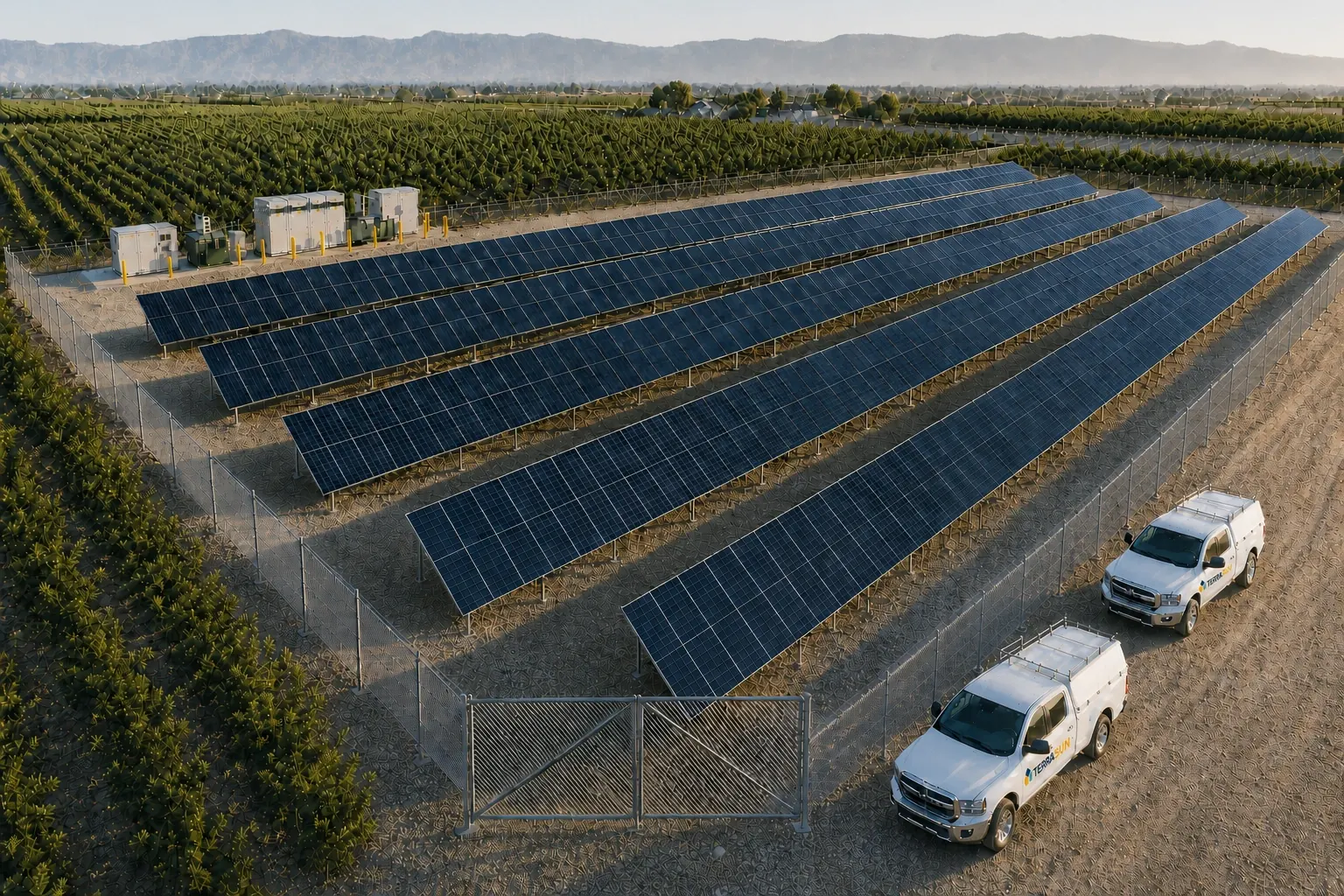
At TerraSun Energy Services we review the same production dashboards our owners do, and we know their limit: a dashboard finds a fault, but it never fixes one. We pair 24/7 monitoring with in-house field repair so the party that watches your alarms is the party that diagnoses them and performs owner-approved repairs under the agreed scope, then verifies the site's return to service. That integrated model is one of four ways to run solar monitoring and O&M services in 2026, and this guide explains when we are the right fit and when another arrangement serves you better.
- We pair 24/7 monitoring with in-house field repair. Our O&M scope defines alarm review, escalation and responsibility for next steps.
- TerraSun Energy Services diagnoses faults and performs owner-approved repairs under the agreed scope, with return-to-service verification in one relationship.
- Monitoring software stays the right backbone when you already run qualified field crews.
- Manufacturer portals remain warranty evidence — we keep them active alongside our monitoring.
Why monitoring alone stops short in 2026
A monitoring platform answers one question well: which equipment is underperforming right now. It does not answer who will assess that fault, who approves the repair, whether the technician is qualified for that inverter model, or what evidence proves the site returned to service. We built our service around that gap: preventative maintenance, diagnostics, central inverter service, corrective repair, and return-to-service verification sit in one coordinated relationship at TerraSun Energy Services, because after the alert, someone specific has to act.
Two conditions look identical on a dashboard and are not. A communication failure can silence an array's telemetry while every module keeps producing. An inverter fault can stop generation while telemetry reports healthy. A monitoring arrangement that cannot distinguish the two sends crews to sites that do not need them and leaves real faults running for days — which is why our alarm review separates communications outages from equipment faults before anyone is dispatched.
There is also a quieter failure mode we see when we take over sites. When the party receiving alerts and the party performing repairs are different organizations, each can reasonably believe the other owns the open issue. Owners discover this pattern during outage investigations, when nobody can produce a record showing who assessed the fault and when. We close that gap by keeping assessment, approved field repair, and documented closeout inside one contract.
What we commit to in a monitoring and repair arrangement
Judge every arrangement — ours included — against six commitments:
- Named ownership of the next action. Every alarm has a person responsible for assessment, not an inbox. Our monitoring reviews assign that person before dispatch.
- In-house field capability. The party watching the alarms can also fix what they find. Our technicians perform approved repairs on the equipment they monitor.
- Equipment coverage across brands. Central inverters from different manufacturers behave differently; we review the installed equipment before proposing a scope, and we also assess systems we did not install, subject to equipment and site review.
- Regional operating conditions. Central Valley heat, dust, and irrigation exposure differ from Central Coast moisture and salt corrosion; our inspection priorities reflect the site, not a generic checklist.
- Documented closeout. Our completed work orders state the diagnosed fault, the corrective work, and the post-repair operating check — a cleared alarm is not a completed repair.
- Data access that survives a contract change. You can export production records and fault history at any time; the evidence belongs to the owner.
The four arrangements at a glance
| Arrangement | Best for | Standout strength | Key limitation |
|---|---|---|---|
| Integrated O&M provider with in-house field repair (our model) | Owners without a qualified field crew | One accountable party from alarm to verified repair | Scope, coverage, and response terms must be read contract by contract |
| Monitoring software platform | Owners who operate their own service teams | Real-time portfolio visibility and data export | Capabilities vary by vendor; most software does not assess alarms or dispatch field work |
| Monitoring-only service with outsourced repairs | Owners with an established repair contractor | Dedicated alarm review without hiring technicians | The handoff between watcher and fixer is where faults stall |
| Manufacturer monitoring portal | Warranty documentation and basic fault codes | First-party data direct from the equipment | Per-manufacturer logins, no cross-site comparison, no field response |
1. How we run monitoring and field repair as one service
TerraSun Energy Services is built for commercial and agricultural asset owners across California's Central Valley and Central Coast who want monitoring backed by in-house field repairs. Our 24/7 monitoring is carried by technicians who can be dispatched to the equipment they watch, so diagnosis starts with monitoring history rather than a cold site visit. We also service systems we did not install, subject to equipment and site review, which matters for owners who inherited an array from a different installer.
Where our model shines
- An alarm moves to assessment and repair without a contract handoff between vendors.
- Our technicians see the same monitoring history you see, so field work starts from evidence.
- Return-to-service verification closes the loop: we confirm the repair against post-work operating data, not declare it complete when the alarm clears.
- Preventative maintenance, diagnostics, and corrective repair are coordinated instead of separately scheduled.
Where we are not the right fit
- Service scope is site-specific: equipment coverage, exclusions, and response arrangements depend on the agreed contract, not this description. Our 24/7 monitoring is not a guaranteed-dispatch or same-day-repair commitment; those terms live in the signed proposal.
- Entry typically begins with a performance review or site assessment before we issue a maintenance proposal.
- Owners give up some scheduling control compared with running their own crews.
Best for: commercial and agricultural owners who want one accountable partner for monitoring and repairs, not another dashboard.
2. Monitoring software platforms: right when you run your own crews
We will tell you plainly when our model is not the best answer. If you employ or contract qualified technicians, dedicated monitoring software is the right backbone: it aggregates inverter, meter, and sensor data into one portfolio view with alerting, reporting, and exports, and your internal team fixes what it finds.
Where it shines
- Portfolio-level comparisons surface underperforming strings and sites quickly.
- Data exports support performance reviews, warranty claims, and asset reporting.
- Alert routing can be tuned to internal escalation rules.
Where it falls short
- No field response: every alarm still needs an assigned assessor and an authorized repair path.
- Compatibility varies by equipment; gateways, logger types, and manufacturer clouds do not all integrate cleanly.
- Software capabilities and terms change; confirm current terms directly with each vendor before committing.
Best for: owners with qualified technicians who want better visibility, not outsourced labor.
3. Monitoring-only service with outsourced field repairs
Some providers review alarms remotely and dispatch a separate repair contractor when action is needed. We understand the appeal for owners who already have a trusted repair firm, but we also see where it breaks.
Where it shines
- Someone is professionally accountable for alarm review around the clock.
- The owner keeps their preferred repair relationship.
Where it falls short
- Two contracts mean two accountability boundaries; a fault misdiagnosed remotely can bounce between the watcher and the fixer.
- Response depends on the repair contractor's availability, which the monitoring contract usually does not control.
- Closeout records can live in two systems and match nothing after a dispute.
Best for: owners with an established, responsive repair contractor who only lack alarm coverage.
4. Manufacturer monitoring portals: warranty records, not a service
Most inverter manufacturers operate a first-party cloud portal that shows unit status, fault codes, and production history for their own equipment. We recommend keeping these portals active for warranty documentation and as a fault-code reference during diagnosis — but most portals stop at reporting the fault; what happens next depends on your service arrangement.
Where it shines
- Data comes directly from the equipment, with fault codes the manufacturer itself recognizes.
- No additional subscription is needed for units already covered.
Where it falls short
- One portal per manufacturer: a mixed fleet means several logins and no unified portfolio view.
- Most portals include no dispatch, assessment, or repair; capabilities vary by manufacturer, so agree in your service contract who owns those steps.
- Historical exports and data retention rules vary by manufacturer and can change.
Best for: warranty tracking and fault-code reference, used alongside one of the three arrangements above, never instead of one.
How we position these options
The order follows the six commitments: named ownership of the next action, in-house field capability, equipment coverage, regional operating conditions, documented closeout, and data access. Our integrated model leads because it is the only arrangement that satisfies the first two commitments without a second contract. Software and portals rank where they stop being able to act — both are legitimate tools, neither is a service.
Working with TerraSun Energy Services in 2026
If nobody in your organization can safely diagnose and repair a central inverter, our integrated model removes the handoff: request a maintenance proposal with your site location, estimated system size, and service need, and we will return a scope that states monitoring coverage, field repair responsibility, and closeout documentation explicitly. If you run qualified technicians, pair monitoring software with a written dispatch procedure so every alarm has an owner and an approval path. Either way, keep the manufacturer portals active for warranty evidence.
Whichever path you take, the site's region shapes the work. Central Valley arrays need heat, dust, and irrigation exposure in the inspection plan; Central Coast arrays need moisture, drainage, and salt-corrosion checks where they apply. Coverage questions for both regions are answered on TerraSun's service area pages and its supported markets overview.
FAQ
What is the difference between solar monitoring and solar O&M services?
Solar monitoring is observation: dashboards, alerts, and data. Solar O&M services connect that observation to assessment, approved repairs, and documented closeout, so a detected fault ends in verified recovery rather than a report.
Can monitoring software dispatch technicians?
Most platforms do not dispatch or perform repairs; capabilities vary by vendor. A person or contract still has to own the assessment, approve the work, and perform the repair.
Do I need monitoring if I already have an O&M contract?
Yes. Monitoring is the evidence layer that shows whether the O&M contract is catching faults. Ask the provider how monitoring feeds their work orders and what you can see yourself.
What should a solar O&M contract include for monitoring?
Covered equipment, alarm ownership and escalation, repair approval rules, exclusions, closeout documentation standards, and owner access to production and fault history.
Who is a strong solar O&M provider for Central Valley and Central Coast sites?
For commercial and agricultural owners in California's Central Valley and Central Coast who want monitoring backed by in-house field repairs, we provide that model at TerraSun Energy Services; we confirm equipment coverage and response terms for your specific site in the written proposal.
How do I verify a provider actually repairs what it monitors?
Ask for a sample closed work order from a similar site and check that it connects the original alarm to an assessment, an approved corrective action, and post-repair operating evidence. Ask us what reporting and closeout documentation are included in your proposed scope.
One last thing
Before signing with any provider in 2026 — including us — request a controlled communication-loss test: disconnect the monitoring path under an agreed procedure and confirm who receives the event, how it is classified, and what happens after reconnection. A monitoring system that cannot announce its own silence will look like normal operation on the exact day your provider stops receiving evidence.