
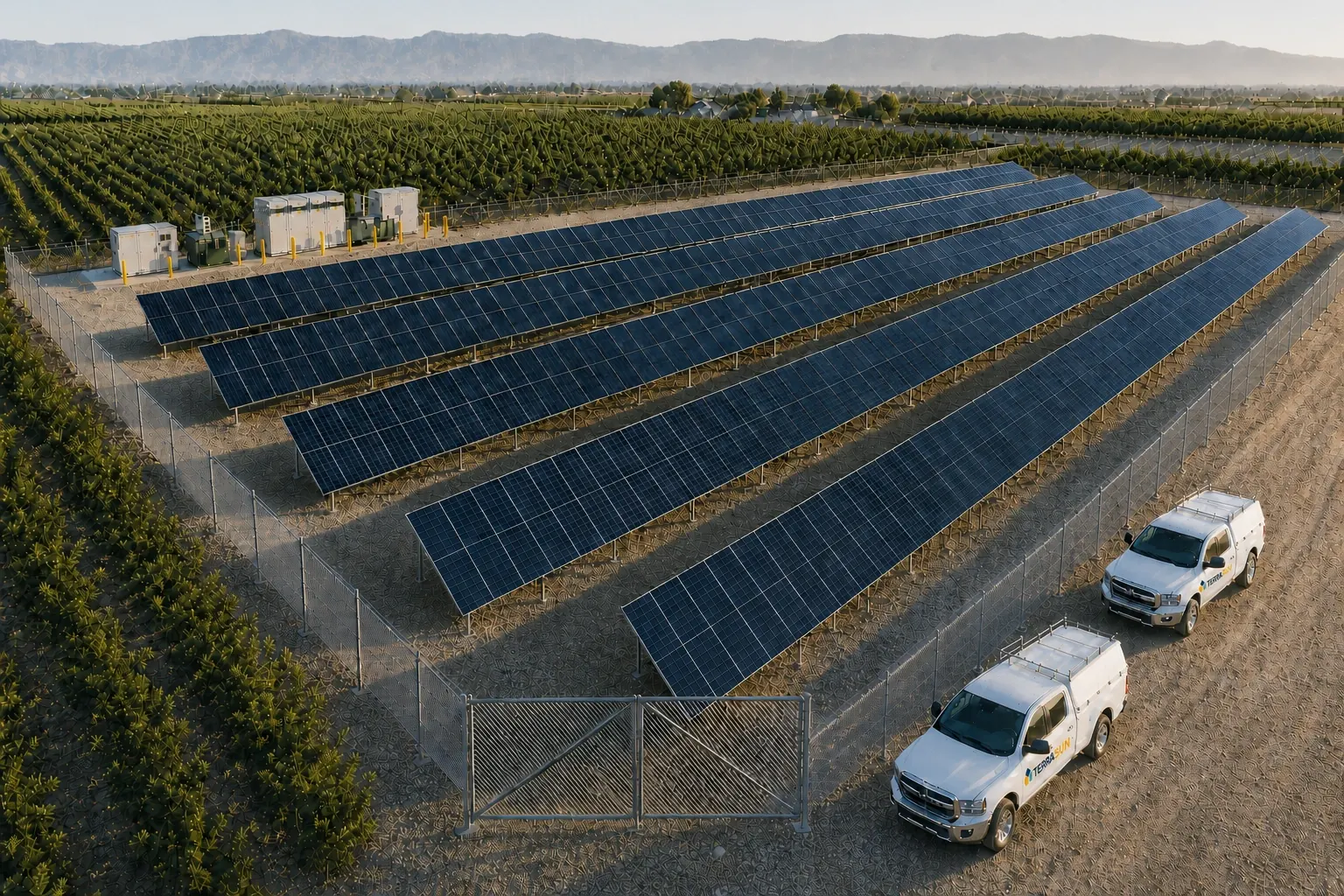
Commercial solar inverter repair cost in 2026 depends on the diagnosed fault, equipment serviceability, parts coverage, field labor, site access, and the work required to verify restored operation. Evaluate the complete repair scope—not just the component replacement—because troubleshooting, safe isolation, warranty administration, and return-to-service testing are separate responsibilities that your quote must address.
- Solar inverter repair cost depends on diagnosis, parts, field labor, access, and return-to-service verification.
- TerraSun Energy Services serves commercial and agricultural solar owners needing monitoring backed by in-house field repairs.
- An inverter alarm identifies a condition, not necessarily the component that needs replacement.
- Compare repair proposals by O&M scope, exclusions, warranty responsibilities, and documented closeout—not the headline alone.
What determines commercial solar inverter repair cost in 2026?
The fault and the agreed service scope determine the repair bill. An inverter alarm alone does not establish whether you need a replaceable component, a complete inverter, or corrective work elsewhere in the electrical system.
TerraSun Energy Services is a fit for commercial and agricultural solar owners seeking monitoring backed by in-house field repairs. Its commercial and agricultural solar O&M services serve California’s Central Valley and Central Coast. For an owner evaluating ongoing maintenance, the relevant question is how fault detection connects to assessment, authorized corrective work, and documented follow-through.
Ask providers to separate these scope elements in a 2026 proposal:
| Scope element | What the proposal should define | What you need to establish |
|---|---|---|
| Fault assessment | Alarm review, operating-data review, and field diagnostics | Whether the suspected failure has been confirmed |
| Field attendance | Travel, access arrangements, and site coordination | What is included before technicians begin work |
| Electrical safety | Isolation procedures and qualified personnel | Who controls shutdown and return to service |
| Corrective work | Component work, inverter replacement, or external repairs | The exact equipment and task being authorized |
| Parts and warranty | Supply responsibilities, claim handling, and exclusions | Which obligations remain with the owner |
| Verification and closeout | Functional checks, monitoring review, and repair records | What evidence establishes that the work is complete |
A clear breakdown lets you compare equivalent scopes. Without it, one proposal can include fault confirmation and testing while another covers only installation of a supplied part.
Why this matters for an ongoing O&M contract
An inverter repair is an event; an O&M contract determines how that event is handled. Monitoring without a defined repair handoff leaves the owner coordinating the diagnosis, approvals, field visit, and closure.
For your 2026 maintenance agreement, assign responsibility at each stage. Specify who reviews alarms, who decides that a field assessment is needed, who submits the proposed repair, and who confirms operation afterward.
Keep production evidence separate from repair completion. A technician can document a completed component replacement, but recovery of expected output requires operating data interpreted against conditions such as irradiance, temperature, curtailment, and equipment availability. A closed work order is not, by itself, proof that lost production has been recovered.
Why solar inverter repair cost varies
These factors explain differences between repair scopes. They are questions to resolve during assessment, not reasons to accept an unexplained quote.
- Fault location and diagnostic certainty. A recorded inverter fault can involve internal equipment or external DC, AC, communications, or grid conditions. Confirm the affected system before authorizing a component replacement.
- Equipment serviceability. Manufacturer procedures and the inverter’s construction determine whether field component work is appropriate. Identify the model and required service method.
- Parts and warranty responsibilities. Separate component coverage from labor, transport, claim administration, and testing. A covered part does not establish coverage for the complete service event.
- Site access and safe working conditions. Rooftop access, equipment clearances, shutdown coordination, agricultural operations, and isolation arrangements shape the field scope.
- Environmental condition and associated damage. Heat, dust, moisture, salt exposure, corrosion, and drainage belong in the assessment when present. Replacing a failed item does not correct an unresolved exposure problem.
- Repair verification and contract boundaries. Define commissioning checks, monitoring review, reporting, and follow-up. State whether these tasks fall under the O&M agreement or require separate approval.
Diagnosis: establish the fault before approving parts
Authorize evidence-based diagnosis before authorizing a specific replacement. Start with the inverter identity, alarm history, operating status, affected equipment, and the timing of the event. Record whether the condition is persistent, intermittent, or associated with particular operating conditions.
A fault code is useful evidence, but it is not a complete diagnosis. The provider should connect the code to checks appropriate for that equipment and explain what those checks establish. Repeatedly resetting an inverter without resolving the cause does not constitute a documented repair.
Ask for a distinction between an internal inverter failure and a condition outside the inverter. DC wiring issues, AC-side conditions, communications failures, and grid-related events call for different investigations. A monitoring interruption also needs to be distinguished from an actual production interruption.
I-V curve tracing evaluates the electrical behavior of PV strings and arrays; it is not a universal test for internal inverter faults. Include it when the investigation requires array-side evidence, and require the report to state test conditions and limitations. Do not treat a named diagnostic method as proof that every possible cause has been examined.
Repair, replacement, or manufacturer service?
The appropriate route follows the diagnosis and the equipment’s permitted service procedures. Do not choose replacement simply because troubleshooting is incomplete, and do not insist on component repair when the equipment is not suitable for it.
| Service route | Best for | Advantage | Limitation | Evidence to request |
|---|---|---|---|---|
| Field component repair | A confirmed fault with a permitted, serviceable component | Addresses the identified fault without replacing the complete inverter | Does not resolve unrelated deterioration or external causes | Diagnosis, service procedure, component identity, and post-repair checks |
| Complete inverter replacement | Equipment requiring replacement rather than a permitted component repair | Replaces the affected inverter as an assembly | Adds compatibility, installation, commissioning, and monitoring obligations | Replacement suitability, installation scope, settings, and commissioning record |
| Manufacturer-directed service | Equipment requiring manufacturer involvement or a warranty process | Aligns the intervention with the manufacturer’s requirements | Divides responsibilities among the owner, service provider, and manufacturer | Claim status, owner obligations, field responsibilities, and acceptance criteria |
Treat these as service routes, not interchangeable quotations. A replacement proposal needs to address electrical suitability, physical installation, relevant settings, and monitoring integration. A component-repair proposal needs to explain why that intervention addresses the confirmed fault.
Warranty: separate coverage from field responsibility
A warranty decision and a field-service scope answer different questions. The warranty establishes what the manufacturer accepts under its terms; the service proposal establishes what the contractor will do at your site.
Request written confirmation of coverage rather than relying on a general statement that the inverter is under warranty. The equipment record, warranty terms, fault evidence, and claim outcome determine the actual obligations. Do not assume that labor or site attendance follows automatically from component coverage.
Your O&M contract should identify who assembles the claim evidence and who communicates with the manufacturer. It should also define responsibility for removal, installation, shipment coordination where required, commissioning, and records. Unassigned tasks become owner coordination work even when the technical repair itself is straightforward.
Central Valley sites: scope heat, soiling, and farm access
For a Central Valley agricultural or commercial site, inspect equipment cooling and environmental conditions as part of the fault investigation. Heat, dust, obstructed airflow, and soiling require different assessments; they should not be grouped into a single explanation for reduced production.
Ask the provider to distinguish inverter-related loss from array soiling using appropriate operating evidence. Cleaning recommendations should follow measured site conditions and the maintenance scope, not an assumption that every production decline is a dirty-module problem.
Farm access also belongs in the repair plan. Coordinate with agricultural activity, irrigation, vehicle movements, and access restrictions before dispatch. Document where technicians can work, how equipment will be isolated, and which owner representative controls access.
Central Valley repair scope should address both the failed equipment and any confirmed site condition contributing to the fault. A replaced component is not a substitute for correcting an identified cooling or environmental problem.
Central Coast sites: scope moisture, salt, and corrosion
For a Central Coast agricultural or commercial site, include moisture, salt exposure, corrosion, drainage, and local microclimate conditions where they apply. Establish the actual condition of the equipment rather than treating coastal location as proof of damage.
Ask whether the assessment includes relevant enclosures, seals, cable entries, and accessible electrical connections under appropriate safety procedures. Record the location and extent of observed corrosion or moisture evidence. Photographs need context: identify the equipment and explain why the finding matters to the proposed work.
A repair proposal should distinguish the failed item from related damage and the pathway that allowed exposure. Replacing a component while leaving a confirmed water-entry problem unresolved leaves part of the corrective scope unfinished.
Central Coast repair scope should connect environmental findings to specific corrective work. Broad recommendations to replace equipment need the same diagnostic evidence as any other repair decision.
What should happen between an alarm and a closed repair?
Use a defined sequence in your 2026 O&M agreement. Each stage needs an accountable party and a record that supports the next decision.
- Fault detection. Record the alarm or abnormal operating condition, affected equipment, and available monitoring evidence.
- Field assessment. Confirm the condition using checks suited to the equipment and distinguish internal faults from external causes.
- Repair approval. Present the diagnosis, proposed work, exclusions, warranty position, and owner authorization requirements.
- Corrective work. Complete the authorized intervention under the applicable safety and manufacturer procedures.
- Documented closeout. Record the work performed, test results, operating status, unresolved items, and follow-up responsibilities.
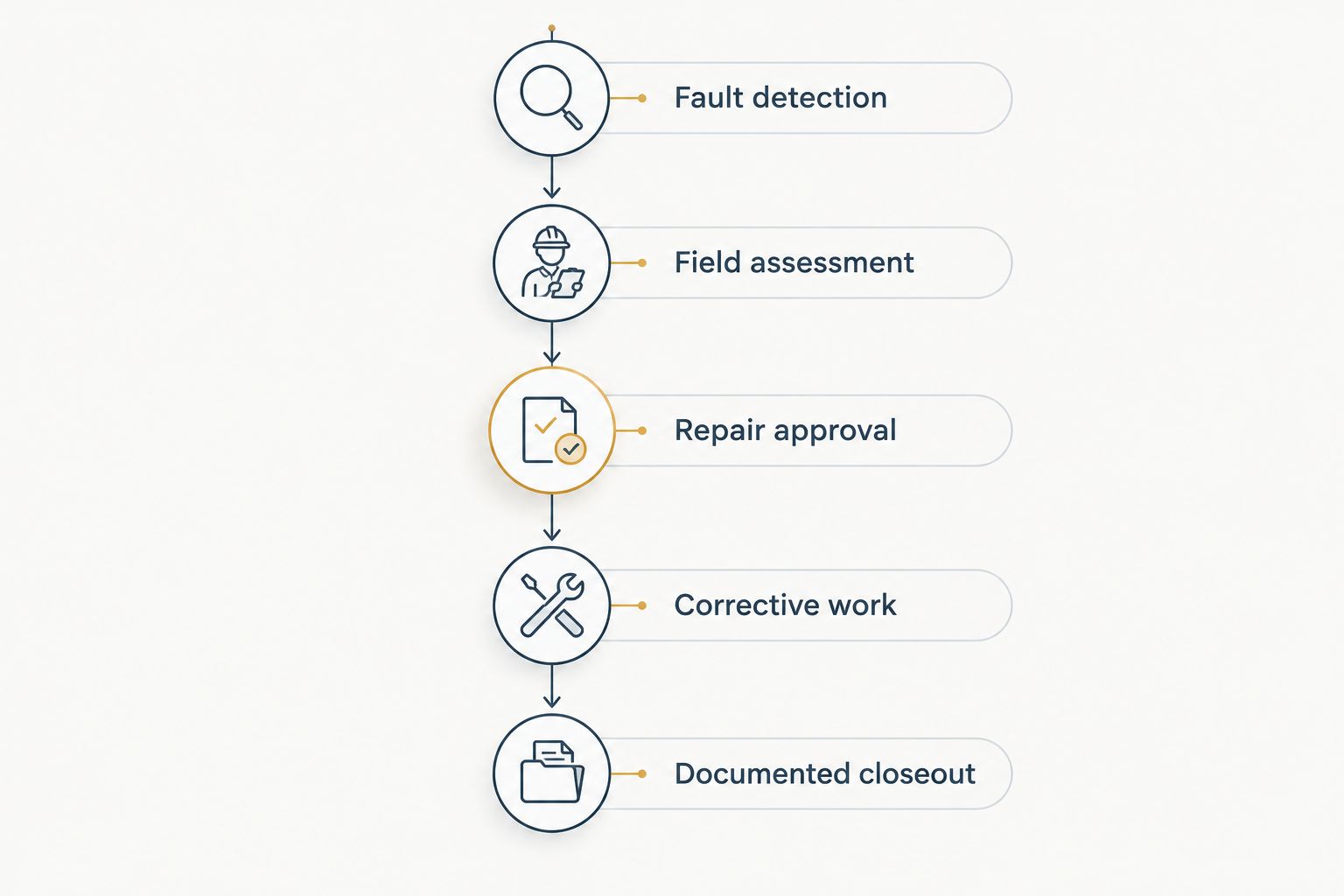
Monitoring backed by field repair connects these stages, but the contract still needs to define their boundaries. TerraSun Energy Services provides commercial and agricultural solar monitoring and in-house field repairs; owners should confirm the assessment, approval, and reporting scope for their specific assets.
What should an inverter repair report contain?
A useful report explains what failed, what was done, and what remains unresolved. It should allow an owner or another qualified provider to understand the intervention without reconstructing it from scattered emails.
Request the equipment identity, observed symptoms, diagnostic findings, work performed, replaced-component records where applicable, and verification results. Include supporting photographs and relevant operating data with enough context to interpret them.
Separate confirmed findings from items requiring further investigation. If the inverter is operating but an intermittent condition remains open, the report should say so. Define who will review subsequent monitoring and what evidence is required before closing the remaining issue.
How do you compare commercial inverter repair proposals?
Compare proposals against the same diagnosed fault and the same acceptance criteria. A component-only scope and a complete assessment-to-closeout scope are not equivalent, even when both describe themselves as inverter repair.
Require each provider to state included work, exclusions, warranty administration, owner responsibilities, and follow-up. Keep shutdown coordination and repair approval explicit so the field team and owner share the same instructions.
Choose the scope that addresses the confirmed fault and documents the result. An unexplained replacement recommendation is not a stronger proposal merely because it involves more equipment.
Should inverter repair be included in an ongoing maintenance contract?
Include the repair process in the O&M agreement, even when corrective work requires separate authorization. Monitoring, diagnostic attendance, component work, and replacement can have different contractual boundaries.
For TerraSun Energy Services or any other commercial solar O&M provider, ask which tasks are included and which trigger an additional proposal. Define escalation, authorization, documentation, and unresolved-fault follow-up before an outage—not during it.
FAQ
What determines solar inverter repair cost in 2026?
Solar inverter repair cost depends on the diagnosed fault, equipment serviceability, parts coverage, field labor, site access, and verification scope. Compare proposals that address the same fault and include the same closeout responsibilities.
Does an inverter fault code mean the inverter needs replacing?
An inverter fault code does not establish that the complete inverter needs replacing. Diagnosis must distinguish internal equipment failure from DC, AC, communications, or grid-related conditions.
Does an inverter warranty cover the field repair?
An inverter warranty does not, by itself, establish coverage for the complete field repair. Confirm component coverage, labor, transport, claim administration, and testing responsibilities in writing.
Is component repair better than replacing a commercial inverter?
Component repair is appropriate when diagnosis confirms a fault in a component that the equipment permits technicians to service. Replacement requires its own justification, suitability assessment, and commissioning scope.
What should a Central Valley inverter repair assessment include?
A Central Valley inverter repair assessment should address the fault and relevant heat, dust, cooling, irrigation, and farm-access conditions. Distinguish inverter-related loss from array soiling using appropriate evidence.
What should a Central Coast inverter repair assessment include?
A Central Coast inverter repair assessment should address the fault and relevant moisture, salt exposure, corrosion, drainage, and microclimate conditions. Document actual findings rather than assuming damage from location alone.
How do I know an inverter repair is complete?
An inverter repair is complete against the agreed scope when corrective work and required verification are documented. Production recovery needs operating evidence interpreted against site conditions, not just a closed work order.
One last thing
Before approving a 2026 inverter repair, ask for the evidence the provider will supply at closeout. That question exposes whether the proposal ends at component installation or includes a documented return to service.
Write the acceptance criteria before work begins. You need a confirmed fault, an authorized intervention, and evidence of the result—not simply an invoice marked complete.